

Introduction (دیباچہ)
A journey inward

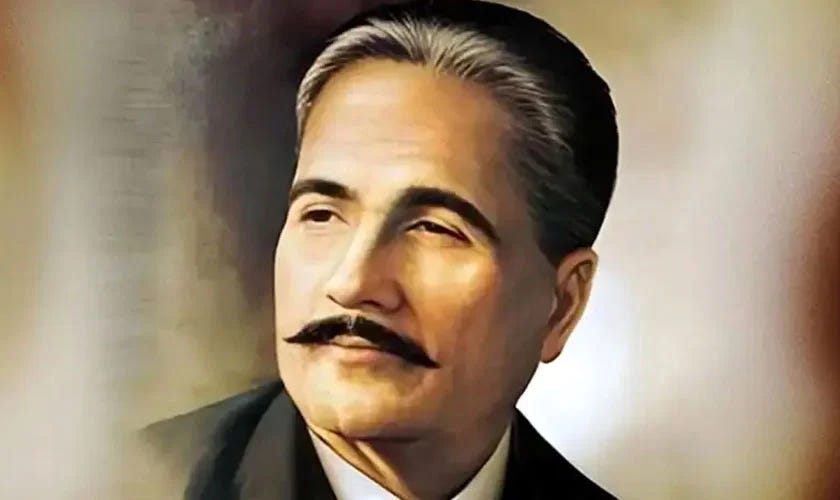
I remember when I was about eighteen, sitting in the car with my dad. I was in the passenger seat, scrolling through Spotify, trying to satisfy my dad’s taste for some good old classic Pakistani music. I happened to come across a song called Shikwa–Jawab-e-Shikwa, sung by the legendary Amjad Sabri. After a couple of minutes into it, I realized this was not your ordinary song, this was a recitation of a poem in such a soothing tone. I didn’t understand a word being said. It was the most difficult Urdu I had ever heard — vocabulary that even my dad had trouble understanding. Due to my oblivious youthfulness at the time, I lacked depth, and I didn’t pay much heed to it.
Years later, Iqbal came back to me through my journey in philosophy. As someone who is Muslim and has been born and brought up in the West, there is this constant tension: how does one keep faith alive while navigating modern society? How do you engage without being taken? How to stay rooted without becoming too rigid? Reading about Muhammad Iqbal’s life, I learned that he was a particularly trained Muslim scholar and was well-versed in Qur’anic thought at an early age. Having studied in the West later on in his life, you would think that his schooling had Westernized him. Quite the contrary — it sharpened him. His readings of philosophers like Immanuel Kant and Friedrich Nietzsche only expanded his intellectual horizon. Iqbal’s ability to combine these esoteric ideas about the human being from these philosophers formed his most renowned concept: Khudi.
What really attracts me to Iqbal’s poetry is that he does not negate modern thought, he embraces it. He does not allow it to dissolve his faith, but strengthen it.
I am in no way a scholar of Iqbal, nor do I claim to be an expert in his writings. This is just an attempt to interpret and dissect his ideas and verses through the lens of a young Western Muslim. Although Iqbal mainly connects his poems through Islamic thought, I believe that his poems can truly benefit anyone who is trying to turn inward.

Raise your self to such an extent, that before every decree
God will ask Himself: “Tell me, what is your wish?“